FCA (Formative Continuous Assessment)
Assessment for Learning, Not Just Assessment of Learning
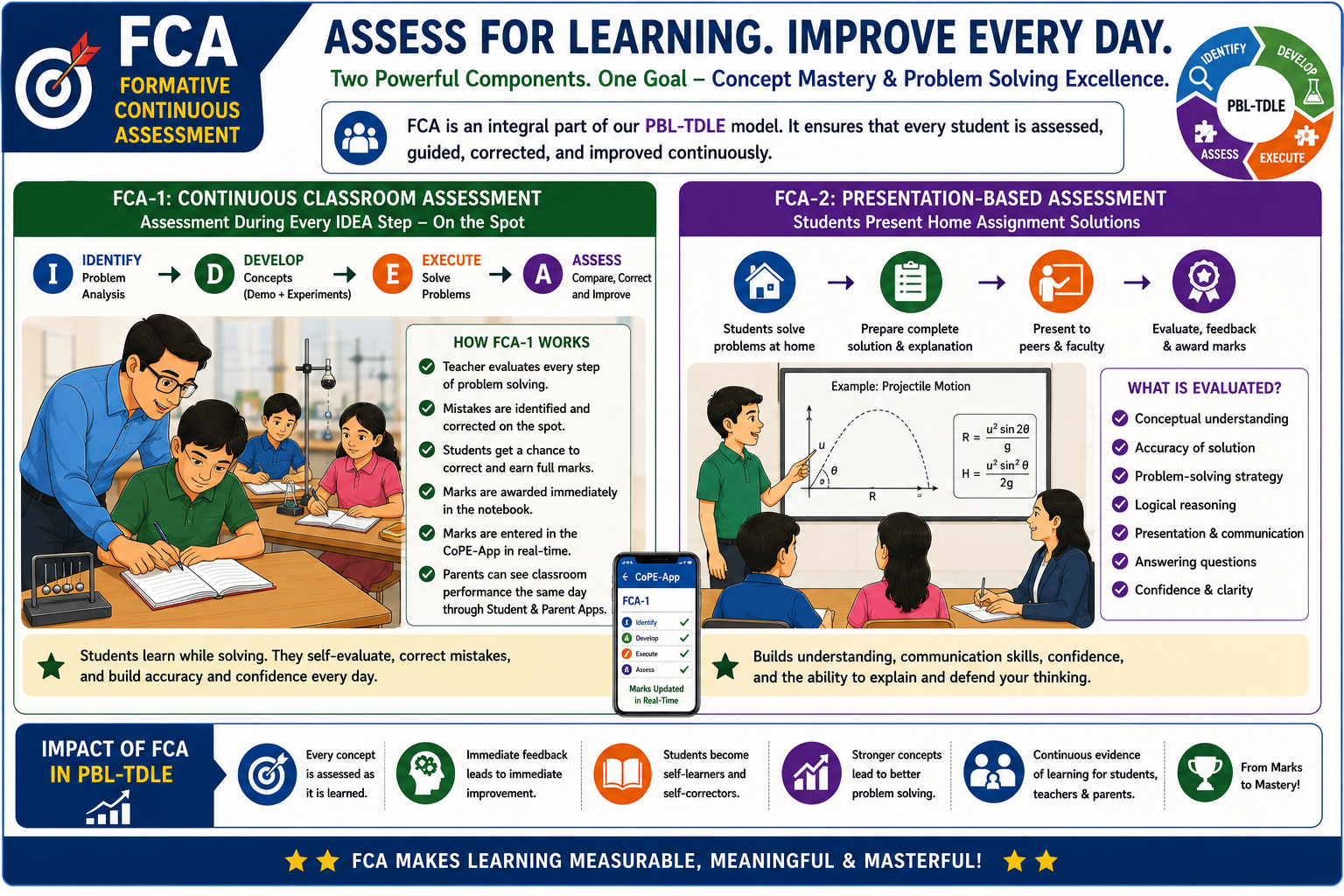
FCA-2: Presentation-Based Assessment
Learning does not end when the classroom session is over.
Students are assigned carefully designed problem-solving or presentation-based home assignments that require them to apply the concepts developed during class. They independently prepare complete solutions, explanations, diagrams, calculations, or presentations at home.
During the next classroom session, students present their work before their classmates and the teacher. Rather than simply submitting written answers, they are expected to explain their reasoning, justify every step, answer questions, and demonstrate conceptual understanding.
The teacher and peers evaluate the presentation on multiple parameters, including:
Conceptual understanding.
Accuracy of scientific reasoning.
Logical problem-solving approach.
Quality of explanations.
Communication and presentation skills.
Ability to respond to questions.
Confidence and clarity of thought.
Constructive feedback is provided immediately, allowing students to refine both their conceptual understanding and communication skills. This collaborative evaluation process encourages active participation, develops confidence, and fosters a culture of peer learning.
The Role of FCA in the PBL-TDLE Model
Within the PBL-TDLE framework, FCA serves as the bridge between concept development and concept mastery.
Instead of relying on occasional unit tests or end-term examinations, learning is verified continuously through authentic classroom activities. Students receive immediate feedback while they are learning, enabling misconceptions to be corrected before they become permanent.
This continuous assessment system ensures that:
Every concept is assessed as it is learned.
Every problem becomes a learning opportunity.
Every mistake becomes an opportunity for improvement.
Every student receives timely guidance and support.
Every classroom generates measurable evidence of learning.
By combining FCA-1 (Continuous Classroom Assessment) and FCA-2 (Presentation-Based Assessment), the PBL-TDLE model develops not only strong conceptual understanding and problem-solving ability but also communication, critical thinking, self-reflection, and confidence.
Most importantly, FCA transforms assessment from a system of awarding marks into a system for developing learners. Students do not study merely to perform in examinations; they learn to think scientifically, solve problems systematically, evaluate their own work critically, and communicate their ideas effectively.
This is why FCA is a cornerstone of the THECREATOR PBL-TDLE model, making learning continuous, measurable, evidence-based, and student-centred.
Learn → Apply → Assess → Correct → Improve → Master is the continuous cycle that drives sustained academic growth and develops confident, independent problem solvers.
One of the distinguishing features of the THECREATOR PBL-TDLE (Problem-Based Learning through Teaching by Demonstrations and Learning by Experiments) model is its Formative Continuous Assessment (FCA) system. Unlike conventional assessment, which primarily measures learning after teaching is complete, FCA is designed to improve learning while it is taking place.
Assessment is integrated into every classroom activity, making it an essential part of the learning process rather than a separate event.
FCA-1: Continuous Classroom Assessment
FCA-1 is conducted during every classroom session while students work through the IDEA Pedagogy.
As students progress through the four stages of Identify, Develop, Execute, and Assess, the teacher continuously observes, guides, evaluates, and provides immediate feedback. Every component of problem solving is assessed on the spot, including:
Identification of the given inputs, desired outcome, and unknown concepts.
Participation during demonstrations and experiments.
Observation, measurement, data collection, and analysis.
Development and verification of concepts.
Application of concepts while solving problems.
Logical reasoning, calculations, presentation of solutions, and final answers.
Unlike traditional assessment, mistakes are not penalized immediately. Instead, students receive instant feedback and are encouraged to identify and correct their own errors during the lesson. Once the correction is made and the correct understanding is demonstrated, students are awarded the full marks for that component.
This approach transforms assessment into a powerful learning tool. Students learn why a mistake occurred, how to correct it, and how to avoid repeating it in the future. Over time, self-evaluation and self-correction become natural habits, enabling students to monitor and improve their own learning.
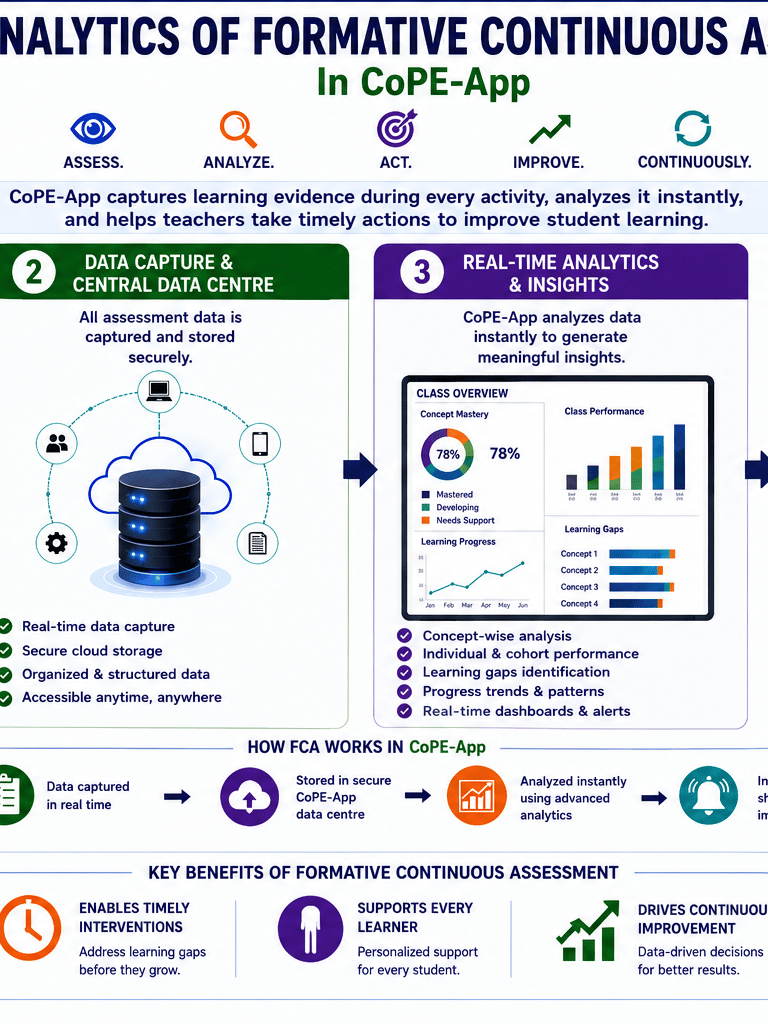
The teacher awards marks immediately in the student's notebook and simultaneously records them in the CoPE-App, creating a real-time digital record of classroom performance. Through the Student and Parent Apps, parents can monitor classroom participation, concept development, and problem-solving progress on the same day.
FCA-1 therefore promotes continuous engagement, immediate improvement, and measurable concept mastery during every lesson.
Learning Analytics: Transforming STEM Education Through Evidence-Based Learning
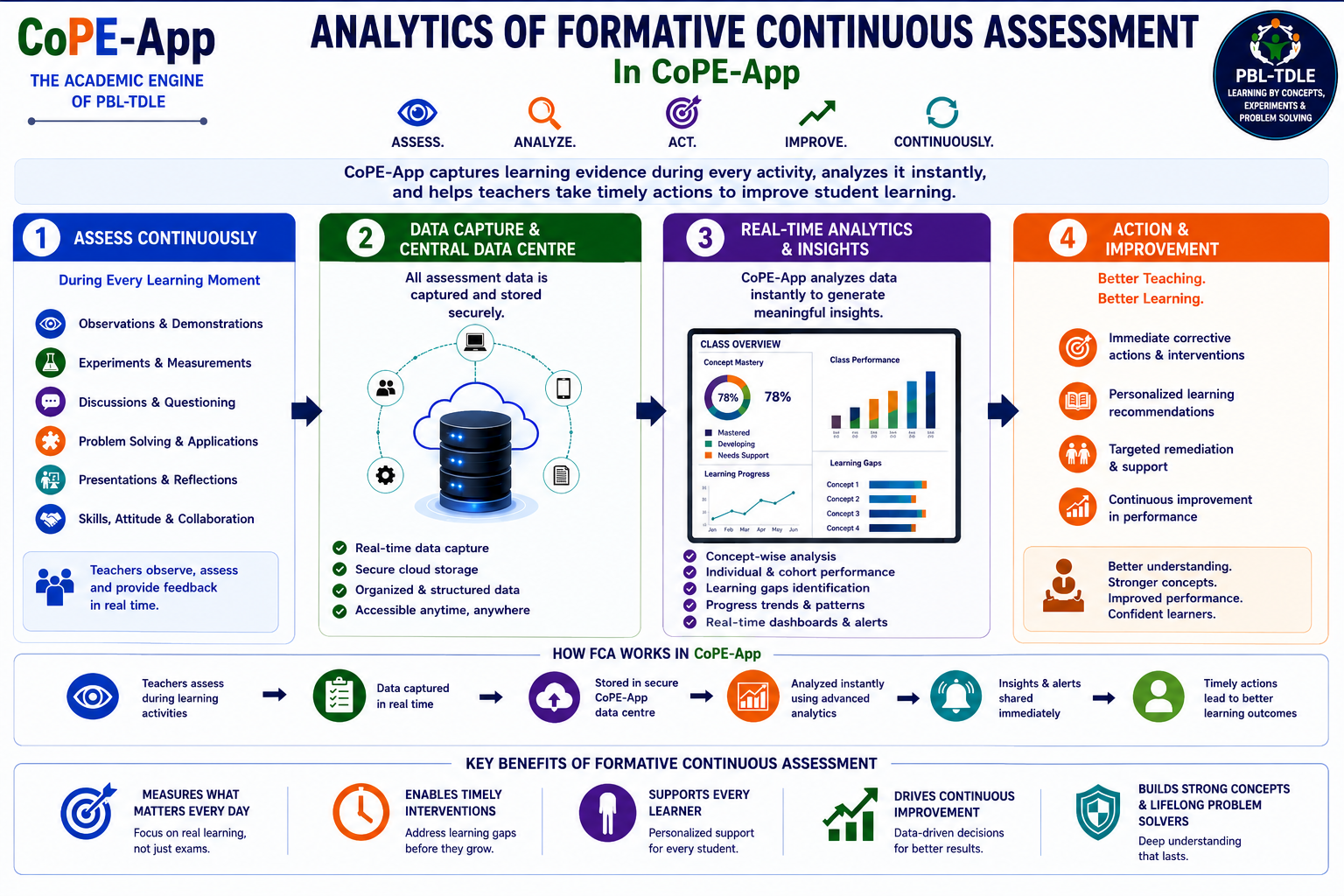
One of the most powerful components of the THECREATOR PBL-TDLE (Problem-Based Learning through Teaching by Demonstrations and Learning by Experiments) model is its comprehensive Learning Analytics System. Unlike traditional classrooms, where learning is judged primarily through periodic examinations, the PBL-TDLE model continuously captures, analyzes, and interprets learning data generated during every classroom activity.
The objective of learning analytics is not simply to collect data, but to convert classroom activities into meaningful evidence that guides teaching, supports students, informs parents, and enables school leaders to make evidence-based academic decisions.
From Marks to Learning Intelligence
Traditional assessment systems generally provide a single score at the end of a chapter or term. Such marks indicate how much a student scored, but rarely explain:
Which concepts have actually been developed?
Which concepts are still weak?
Why is the student making mistakes?
Where is the learning gap?
What intervention is required?
Learning analytics answers all of these questions by continuously monitoring every student's learning journey.
Instead of producing only examination results, the system generates concept mastery profiles, problem-solving analytics, participation records, and learning trends for every student.
Measuring Every Step of Learning
The PBL-TDLE model captures evidence from every stage of the IDEA Pedagogy.
During classroom activities, the system records:
Diagnostic assessment results.
Concept mapping.
Identification of the problem.
Participation in teacher demonstrations.
Student experiments and investigations.
Observation and measurement skills.
Data analysis and interpretation.
Concept verification.
Problem-solving performance.
FCA-1 classroom assessment.
FCA-2 presentation assessment.
Daily homework and presentation quality.
Student participation and engagement.
Every activity contributes to a comprehensive learning profile rather than a single examination score.
Concept Mapping: The Foundation of Analytics
Every STEM topic is divided into clearly defined concepts.
The analytics system continuously identifies:
Concepts already mastered.
Concepts partially developed.
Concepts requiring reinforcement.
Concepts not yet introduced.
Teachers no longer guess what students know. They teach using precise evidence of each student's conceptual understanding.
This enables personalized instruction and targeted interventions before misconceptions become permanent.
Monitoring Problem-Solving Development
Problem solving is a skill that develops gradually through repeated practice.
Learning analytics continuously measures:
Accuracy of solutions.
Logical reasoning.
Selection of concepts.
Problem-solving strategies.
Calculation accuracy.
Common errors.
Improvement over time.
Speed and consistency.
Teachers can therefore monitor not only whether students solve problems correctly, but also how they think while solving them.
Real-Time Feedback for Students
Students receive immediate feedback during every lesson.
They can instantly see:
Which concepts they have mastered.
Which concepts require additional practice.
Errors made during problem solving.
Corrections suggested by the teacher.
Daily progress in classroom activities.
FCA performance.
Because feedback is immediate, students improve continuously rather than waiting until the end of a unit or examination.
Real-Time Academic Visibility for Parents
Parents become active partners in the learning process.
Through the Student and Parent Apps, they receive real-time updates on:
Classroom participation.
Concepts taught during the day.
Experimental activities completed.
Problems solved.
FCA marks.
Teacher feedback.
Concept mastery.
Attendance and academic progress.
Parents no longer receive information only during report card meetings. They can follow their child's learning journey every day and provide timely encouragement and support at home.
Data-Driven Teaching
Learning analytics transforms teaching from intuition-based instruction to evidence-based instruction.
Teachers can easily identify:
Which concepts most students find difficult.
Which demonstrations are producing better learning outcomes.
Which problem types require additional practice.
Which students need immediate intervention.
Which students are ready for advanced challenges.
This enables teachers to optimize classroom time and improve the effectiveness of instruction.
Data-Driven Academic Leadership
For school leaders, learning analytics provides complete academic visibility across classrooms, grades, subjects, and teachers.
Leaders can monitor:
Daily classroom implementation.
Concept development across grades.
Completion of demonstrations and experiments.
Problem-solving activities.
Teacher performance.
Student engagement.
Learning trends across the institution.
Academic progress in real time.
Leadership decisions therefore become based on measurable evidence rather than assumptions or isolated examination results.
Building a Teacher-Independent Academic System
Perhaps the greatest advantage of learning analytics is that it shifts the focus from individual teaching styles to a robust academic system.
When every classroom follows the same structured pedagogy and every learning activity is measured, recorded, and analyzed, the quality of education becomes consistent across teachers and classrooms.
The system ensures that:
Every concept is taught systematically.
Every student is monitored continuously.
Every learning gap is identified early.
Every intervention is evidence-based.
Every improvement is measurable.
This creates a sustainable educational model where quality depends on the strength of the system rather than the capabilities of an individual teacher.
The Impact on Problem-Solving
Problem solving improves only when students repeatedly apply concepts and receive continuous feedback.
Learning analytics strengthens this process by ensuring that:
Students know exactly where they need improvement.
Teachers identify misconceptions immediately.
Parents support learning at the right time.
School leaders ensure consistent implementation.
Progress is monitored continuously rather than occasionally.
As a result, students gradually develop:
Strong conceptual understanding.
Scientific reasoning.
Critical thinking.
Analytical ability.
Confidence in solving unfamiliar problems.
Independent learning habits.
Higher-order problem-solving skills.
A New Paradigm of Learning
Learning analytics transforms education from an examination-driven model into a continuous improvement system. It creates a culture where every classroom activity generates meaningful evidence, every concept is tracked, every problem contributes to learning, and every student receives timely support.
Within the THECREATOR PBL-TDLE framework, analytics is not merely a reporting tool. It is the engine that connects teaching, learning, assessment, feedback, parents, and academic leadership into a single integrated ecosystem.
Measure Every Concept. Analyze Every Learner. Improve Every Day. Master Every Problem.
Our Services
Empowering learning through hands-on experiments and real-world problem solving.


PBL-TDLE
Structured learning with demonstrations, experiments, and problem-solving activities.
Global Pathways
Guiding students to top universities with scholarship and exam preparation support.
Join Innovara Today
Get updates on PBL-TDLE modules